
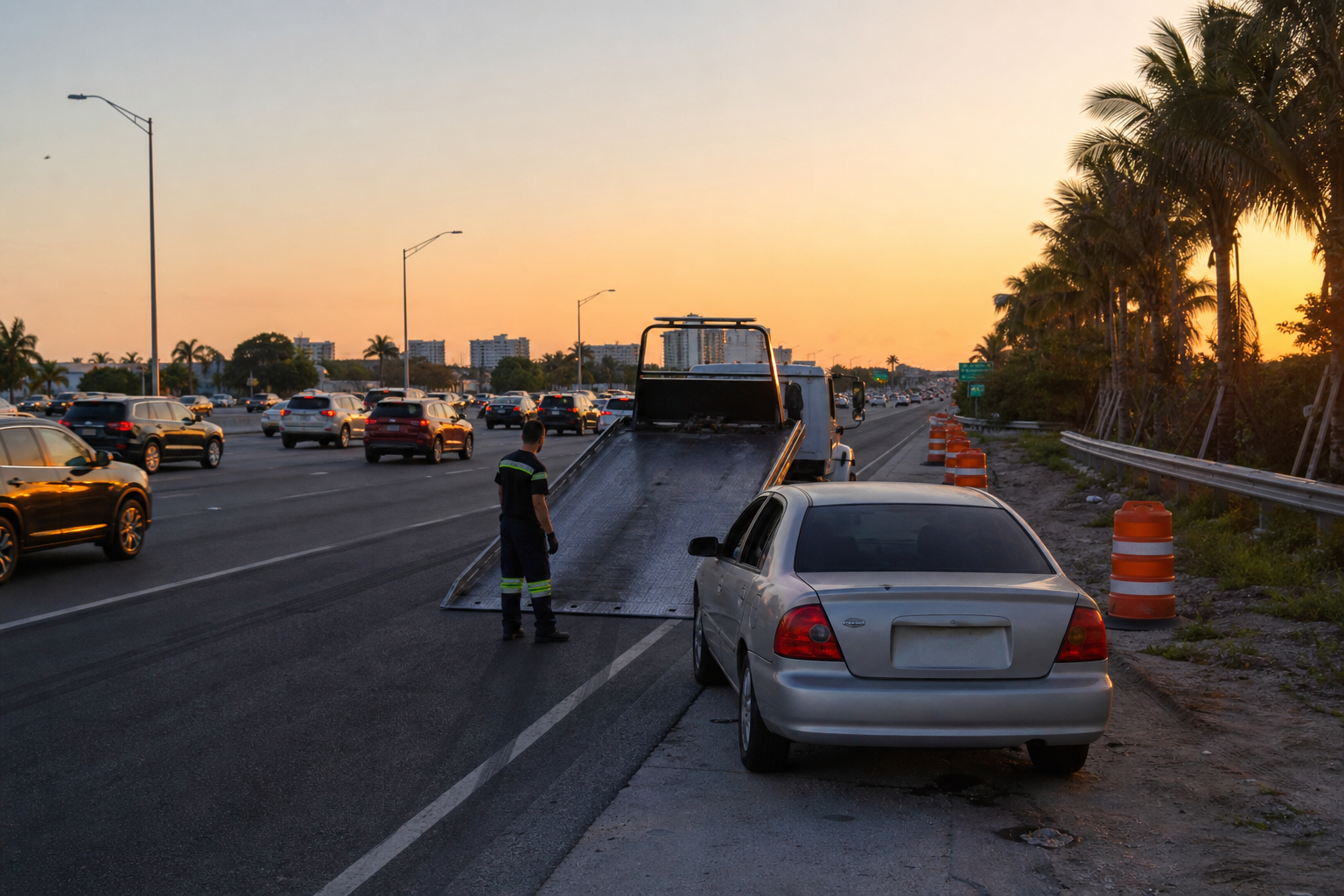
Get Roadside Assistance or Towing After a Stop in West Palm Beach Traffic
Heavy West Palm Beach traffic can leave little room between through lanes, turn lanes, and temporary construction patterns. That changes the response when a vehicle loses power. Your first question is not why it stopped. It is whether the vehicle can roll out of the traffic stream without creating another hazard.
Picture the situation: the engine cuts out while vehicles continue moving around you. A turn lane is close, but no clear shoulder is visible. The vehicle may restart, yet you do not know if it will stall again. Use the sequence below to protect the people in the vehicle, report a useful location, and choose between roadside assistance and a tow.
Make the vehicle visible, then judge whether it can roll
- Turn on the hazard lights. Keep your seat belt fastened while you assess traffic and the vehicle.
- Try one controlled restart. Do not keep cranking the engine or repeatedly switch the vehicle off and on.
- If the vehicle runs and responds normally, move toward the nearest safe area you can actually reach. Use gentle inputs. Do not cut across several busy lanes to chase a more convenient stopping place.
- If it will not move, stop troubleshooting. Set the parking brake and keep occupants inside with their belts on when traffic is passing close by.
- Call 911 if the vehicle is blocking an active lane or anyone faces an immediate danger. Follow the call taker’s instructions. Do not step into traffic to place warning devices or push the vehicle.
- Leave the vehicle only for an immediate threat such as smoke or fire, and only when there is a safe route away from traffic. If circumstances are unclear, stay belted and follow 911 instructions whenever possible.
Once the vehicle is out of the moving lane—or emergency help has been contacted for an active-lane obstruction—you can focus on the service decision.
Use vehicle condition, not convenience, to decide whether to drive
A successful restart does not automatically mean the vehicle should continue through West Palm Beach traffic. Stop and arrange a tow if the engine stalls again or the vehicle shows any of these conditions:
- smoke, a burning smell, or leaking fluid;
- an oil-pressure or high-temperature warning;
- weak or unpredictable braking or steering;
- a flat tire, damaged wheel, or bodywork touching a tire;
- strong shaking, grinding, or repeated loss of power;
- a battery or electrical problem that returns after the restart.
If roadside assistance corrects a limited problem and the vehicle then starts, steers, brakes, and idles normally, ask the provider whether the completed service is consistent with continuing your trip. If symptoms remain or return, do not test the vehicle in dense traffic. Set up a tow instead.
Report a location a service vehicle can approach
A phone map pin is useful, but it may not show which side of the roadway you occupy or what blocks access. Give the provider a short visual description of the pickup point.
- Your direction of travel before the vehicle stopped
- Whether you are in a through lane, turn lane, shoulder, parking area, or construction-shifted lane
- The vehicle’s color, body type, and visible hazard lights
- Nearby cross-street or business names that you can read without leaving the vehicle
- Barriers, cones, curbs, soft ground, low clearance, or traffic that may affect approach
- Whether the vehicle can roll, steer, brake, or shift into neutral
Do not walk along the roadway looking for a better reference point. Read visible information from inside the vehicle, confirm the map pin, and tell the dispatcher if the pin appears to be on the wrong side of the road.
Match the service to what the vehicle can still do
Roadside assistance: Choose roadside assistance when the vehicle is in a reasonably accessible place and the problem may be handled where it sits. Describe the symptoms first so the provider can confirm whether the requested help is available.
Standard towing: Choose towing in West Palm Beach when the vehicle cannot be trusted to continue, needs transport to a destination, or cannot be restored at the roadside.
Flatbed towing: Request flatbed towing when all wheels should remain off the road, the vehicle has wheel or steering damage, ground clearance is limited, or the owner’s manual calls for flatbed transport. Give the vehicle year, make, model, and drivetrain if known.
Help outside regular hours: Use 24-hour towing when the vehicle needs transport at night or another time when your usual service contacts are unavailable. The same location and condition details still apply.
Prepare for a clean service handoff
Before calling, collect the details below. If you cannot safely check an item, say that rather than leaving the vehicle to inspect it.
- Driver name and callback number
- Vehicle year, make, model, color, and plate if available
- Exact vehicle location and direction of travel
- Current symptoms and any dashboard warnings
- Whether the vehicle rolls, steers, brakes, and shifts to neutral
- Keys available and number of occupants
- Requested destination for a tow
- Any access issue around the pickup point
Keep your phone available after the request. Stay with the agreed pickup point unless 911 or the service provider directs you elsewhere. Remove only essential personal items that you can reach without entering traffic.
Choose the next move
- The vehicle is accessible and the issue appears limited: Start Roadside Assistance.
- The vehicle restarted but still shows unsafe or unreliable symptoms: Set Up a Tow.
- The wheels, steering, clearance, or towing instructions require full vehicle support: Select Flatbed Towing.
- The vehicle remains in an active lane: Call 911 first, follow instructions, and arrange towing when it is safe to do so.
Questions drivers ask from the roadside
Should I get out and inspect the vehicle?
Not when moving traffic is close. Stay belted inside unless smoke, fire, or another immediate threat makes remaining there more dangerous. For an active-lane stop, call 911 and follow the instructions provided.
Can I drive after the engine restarts?
Only consider driving if the vehicle runs normally and has no warning lights, leaks, smoke, steering trouble, braking trouble, unusual noise, or repeated stalling. If you are uncertain about its condition, towing avoids testing an unreliable vehicle in heavy traffic.
What if I do not know my exact location?
Share your phone’s map pin, direction of travel, lane position, and any cross-street or business name visible from the vehicle. Explain barriers or construction patterns that could affect access. Do not enter traffic to search for a sign.
Do I need to decide between a standard tow and a flatbed before calling?
No. Report the vehicle type, drivetrain if known, damage, warning signs, and whether it can roll or steer. Mention any towing directions in the owner’s manual. Those details help the provider identify suitable transport.